

History of St. Stephen’s Basilica: 54-Year Build & Collapse
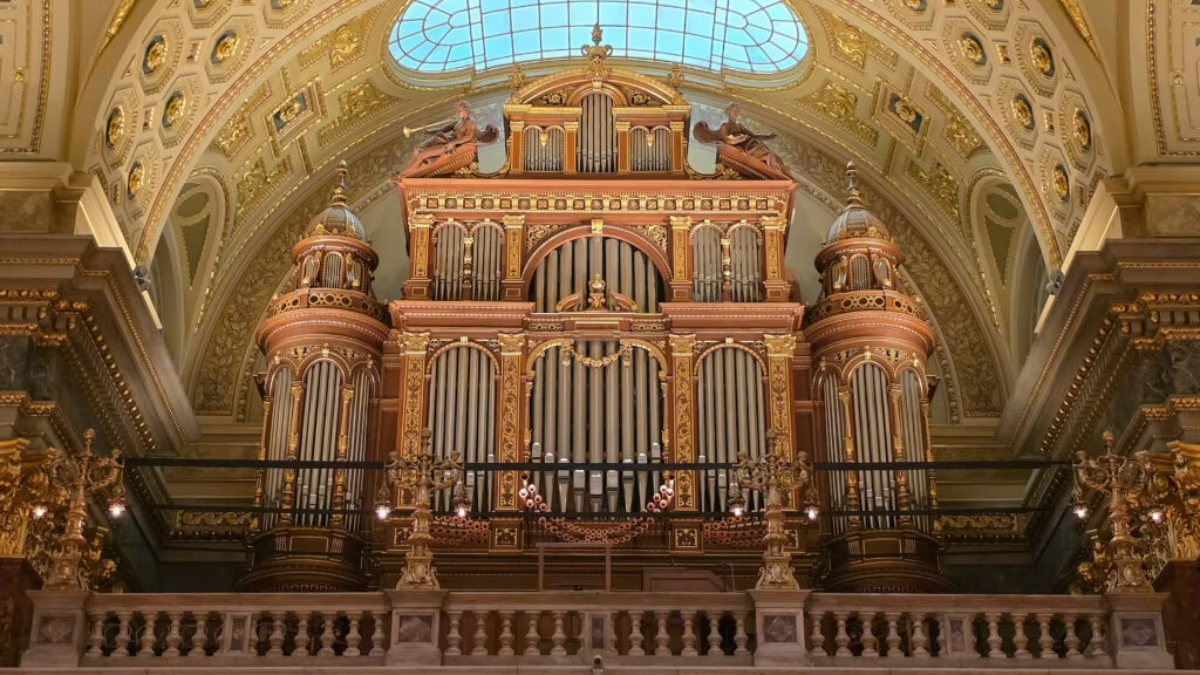
St. Stephen’s Basilica was built between 1851 and 1905 — about 54 years — and named for Stephen I, Hungary’s first king. Construction was interrupted in 1868 when the half-finished dome collapsed in a storm, forcing architect Miklós Ybl to rebuild much of the structure. It was consecrated in 1905 and today serves as a working parish church, a basilica minor, and a co-cathedral of the Esztergom-Budapest Archdiocese.
Few churches in Europe took as long, or went through as much drama, to finish as St. Stephen’s Basilica. What began as a neoclassical design in 1851 became a 54-year project spanning three architects, a dome collapse, and two world wars before it stood as Budapest’s tallest building and its largest church.
This guide walks through why the basilica was built and named for Hungary’s first king, the construction timeline from 1851 to 1905, the 1868 collapse that nearly derailed the project, and what happened to the building through the 20th century and into today.
Why It Was Built and Named for St. Stephen
The basilica was built as a grand new parish church for a rapidly growing 19th-century Pest, and it was dedicated to Stephen I, the first king of Hungary, whose mummified right hand — the Holy Right Hand relic — is enshrined inside.
By the mid-1800s, Pest was expanding fast and its Catholic community needed a church to match the city’s ambitions. The site chosen was a former horse market square in what is now District V, and the new church was dedicated to Stephen I (István), who founded the Hungarian state around the year 1000 and was canonized in 1083. That dedication is more than symbolic: the basilica houses the Holy Right Hand (Szent Jobb), the saint-king’s mummified hand and Hungary’s most venerated relic, still carried in procession every August 20 on St. Stephen’s Day. Our guide to King Stephen I covers his life and why Hungary’s national church bears his name.
Construction Timeline: 1851–1905
Building work began in 1851 under József Hild and continued for roughly 54 years, interrupted by the 1868 dome collapse, until the basilica was finally consecrated in 1905.
Here is the story in order:
- 1851 — Construction begins under architect József Hild, working in a neoclassical style on a Greek-cross floor plan.
- 1867 — Hild dies, with the building still incomplete; Miklós Ybl is brought in to continue the project.
- 1868 — During a storm, the partly finished dome collapses. Much of the completed structure is damaged and has to be demolished and rebuilt.
- 1868–1891 — Ybl rebuilds and substantially redesigns the dome and upper structure, strengthening the engineering and giving the church much of the form it has today. He remains the basilica’s principal architect until his death.
- 1891 — Ybl dies before the work is finished; József Kauser takes over to complete the project.
- 1905 — The basilica is consecrated, 54 years after construction began.
The result of this long, three-architect process is a building that is neoclassical in plan and detailing but structurally more robust than Hild’s original design — a direct legacy of the 1868 failure. Our architecture guide looks closer at the design choices and how the three architects’ work fits together.
The 1868 Dome Collapse
In 1868, the basilica’s half-built dome collapsed during a storm, badly damaging the structure below it and forcing a rebuild that changed both the architect in charge and the engineering of the dome.
The collapse is the single most dramatic event in the basilica’s history. With the dome nearing completion, a storm exposed a structural weakness and brought it down, wrecking a large portion of the work completed to that point. It was a serious setback for a project that had already taken 17 years, and it happened not long after Hild’s death, leaving Miklós Ybl to manage both the loss and the rebuild. Ybl’s response was to rebuild the dome and reinforce the structure beneath it, work that occupied him for over two decades and effectively made him the church’s defining architect. Without the collapse, the basilica now standing in Szent István tér would likely look quite different.
Consecration and the Height Symbolism
The basilica was consecrated in 1905 at a height of 96 meters, tied with the Hungarian Parliament as Budapest’s tallest building — a deliberate reference to 896, the year of the Magyar conquest, and 1896, Hungary’s millennial anniversary.
József Kauser saw the project through to its 1905 consecration, decades after ground was first broken. The finished building reaches 96 meters, matched only by the Hungarian Parliament under a long-standing rule that no Budapest structure exceeds that height. The number is not arbitrary: it points to 896, when the Magyar tribes settled the Carpathian Basin, and to 1896, the year Hungary marked a thousand years since that founding. A basilica dedicated to the country’s first king, reaching a height tied to the nation’s founding date, was very much the point.
The 20th Century: War, the Communist Era, and Restoration
The basilica sustained damage during World War II, continued functioning as a church through the officially atheist communist decades, and has undergone multiple restoration campaigns since, including major exterior and dome work.
The 20th century tested the basilica as much as its construction had. During World War II, Budapest suffered heavy fighting and bombardment, and the basilica sustained damage along with much of the surrounding city; the Holy Right Hand relic itself was moved for safekeeping and later returned. Under Hungary’s postwar communist government, when the state actively discouraged religious practice, the basilica remained an active parish and continued to hold Mass, even as its upkeep suffered from decades of underfunding. Since the end of communist rule in 1989–90, the building has been the subject of repeated restoration campaigns addressing pollution damage, stonework, and the dome, work that has continued into recent years to keep the structure and its façade in good repair.
The Basilica’s Status Today
St. Stephen’s Basilica has been a basilica minor since 1938 and today also functions as a co-cathedral of the Esztergom-Budapest Archdiocese alongside Esztergom Basilica, while remaining a fully active parish church.
Pope Pius XI granted the church the honorary title of basilica minor in 1938, during the Eucharistic Congress held in Budapest that year, recognizing its importance within Hungarian Catholic life. It also serves today as a co-cathedral of the Esztergom-Budapest Archdiocese, sharing that role with Esztergom Basilica outside the capital. None of these titles are ceremonial only — the basilica holds daily Mass, and coming to pray or attend a service is free, separate from the ticketed sightseeing of the church hall, treasury, and panorama terrace. The Holy Right Hand remains the spiritual center of the building, viewable within the church hall on the standard ticket.
Frequently Asked Questions
Why did it take 54 years to build St. Stephen’s Basilica?
Construction ran from 1851 to 1905 because of the scale of the project, the death of two lead architects (Hild in 1867, Ybl in 1891) partway through, and the 1868 dome collapse, which forced a significant rebuild rather than a simple continuation of the original plan.
What caused the 1868 dome collapse?
A storm exposed a structural weakness in the nearly finished dome, causing it to collapse and damage much of the completed structure below. The exact engineering failure is debated by historians, but the result was a lengthy rebuild under Miklós Ybl.
Who were the three architects of St. Stephen’s Basilica?
József Hild began the project in 1851 in a neoclassical style. Miklós Ybl took over after Hild’s death and the 1868 collapse, rebuilding the dome and serving as the basilica’s principal architect for over two decades. József Kauser completed the work after Ybl’s death, leading to the 1905 consecration.
Why is the basilica named after St. Stephen?
It honors Stephen I, the first king of Hungary and founder of the Hungarian state around the year 1000. The basilica also houses his mummified right hand, the Holy Right Hand relic, which is Hungary’s holiest object and gives the dedication a direct physical connection to the saint-king.
Why is the basilica exactly 96 meters tall?
The height matches the Hungarian Parliament by design, under a rule that no building in Budapest exceeds 96 meters. The figure references 896, the year the Magyar tribes settled the Carpathian Basin, and 1896, Hungary’s millennial anniversary.
Was the basilica damaged in World War II?
Yes, it sustained damage during the fighting and bombardment that affected much of Budapest in World War II. The Holy Right Hand relic was moved for safekeeping during the war and later returned to the church.
When did the basilica become a basilica minor?
Pope Pius XI granted it the title of basilica minor in 1938, during the International Eucharistic Congress held in Budapest that year, in recognition of its significance in Hungarian Catholic life.
Is St. Stephen’s Basilica still an active church today?
Yes. It functions as a working parish, holds regular Mass, and serves as a co-cathedral of the Esztergom-Budapest Archdiocese, in addition to being one of Budapest’s most visited monuments. Attending Mass or coming to pray is free; sightseeing the church hall, treasury, and terrace is ticketed.
