

The Holy Right Hand (Szent Jobb) at St. Stephen’s Basilica
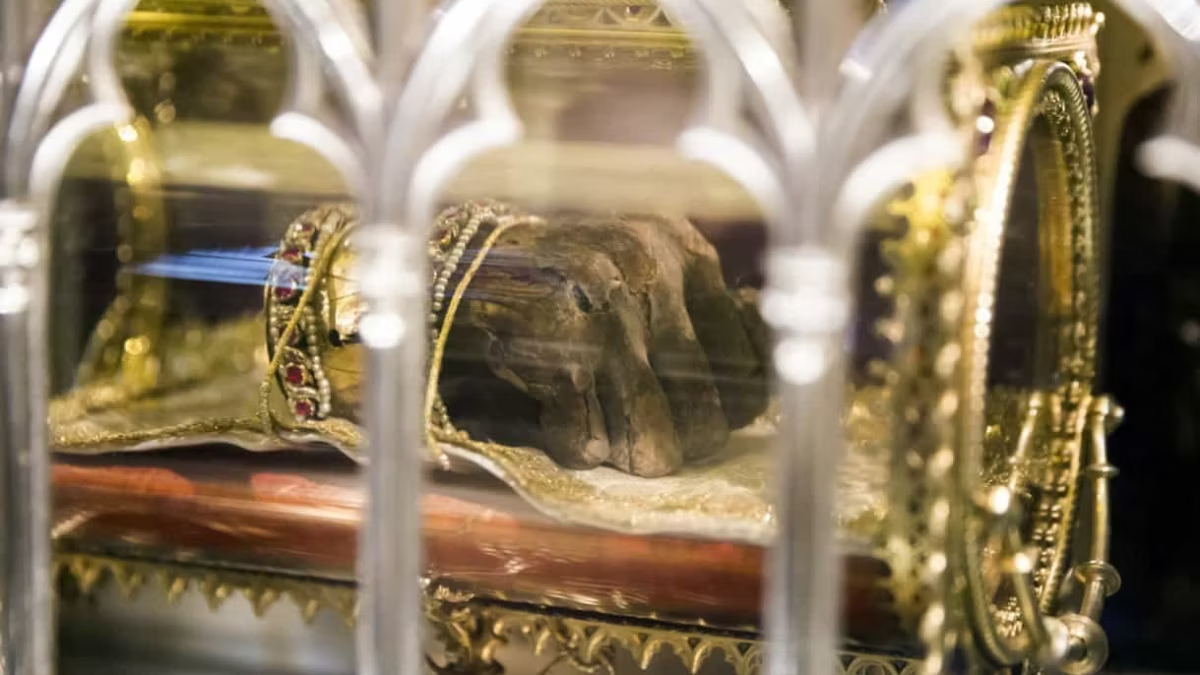
The Holy Right Hand (Szent Jobb) is the mummified right hand of King St. Stephen I, Hungary’s founding king, and is venerated as the country’s holiest relic. It rests in a small reliquary chapel behind the main altar, viewable with a standard church-hall ticket, and a coin-operated light briefly illuminates it. Each August 20, St. Stephen’s Day, it is carried in procession around the basilica and Szent István tér.
Behind the gilded high altar of St. Stephen’s Basilica, in a dim chapel most visitors could easily walk past, sits a jeweled reliquary holding one of Hungary’s most sacred objects: the preserved right hand of the country’s first king. It is a small, quiet sight compared to the dome and the nave’s mosaics, but for many Hungarians it is the reason the basilica bears its name.
This guide covers what the Holy Right Hand is, the story of how it survived nearly a thousand years, where to find it inside the church hall, and what happens on the day each year when it leaves its chapel.
What Is the Holy Right Hand?
The Szent Jobb is the mummified right hand of King St. Stephen I (István), who unified the Hungarian tribes into a Christian kingdom and was crowned around the year 1000. It is regarded as Hungary’s holiest relic and the reason St. Stephen’s Basilica carries his name and dedication.
King St. Stephen I is honored as the founder of the Hungarian state and the king who brought Christianity to the country. When his tomb was opened decades after his 1038 death, his right hand was reportedly found remarkably well preserved, and it was set apart as a relic in its own right. For King Stephen himself, this basilica is Hungary’s national tribute — a building raised specifically to house this relic and honor his memory.
The Relic’s History
Tradition holds the hand was found incorrupt after Stephen’s tomb was opened and was kept as a relic from the 11th century onward. It changed hands and locations repeatedly over the centuries — including time abroad — before being returned to Hungary and eventually placed permanently in Budapest.
The Szent Jobb’s centuries-long journey is part of its story. Medieval accounts trace it to monasteries and royal custody within Hungary, but war, political upheaval, and the Ottoman era repeatedly displaced it. At various points the relic left the country entirely, held for extended periods abroad before being negotiated back to Hungarian hands. It returned to Budapest in the 20th century and has been kept at St. Stephen’s Basilica since, making the basilica’s dedication to the first king more than symbolic — it is the relic’s permanent home.
Because the history involves gaps, competing medieval accounts, and periods where records are thin, exact dates for every leg of the journey are debated among historians. What is well established is the relic’s long veneration and its return to Budapest, where it remains today.
Where to See It
The Holy Right Hand is displayed in a small reliquary chapel directly behind the main altar, at the far end of the nave from the entrance. It sits inside a jeweled, house-shaped reliquary case, and viewing is included with the standard church-hall admission — no separate ticket is needed.
The chapel is easy to miss if you don’t know to look for it, since it sits behind the high altar rather than along the main sightlines of the nave. Visitors approach along the ambulatory behind the altar and find the relic displayed in an ornate metal reliquary. It’s a contemplative, hushed corner of the church, and it’s worth taking a slow lap of the interior to make sure you reach it rather than turning back after the nave and mosaics.
How to See the Relic — the Coin-Operated Light
A coin-operated light box beside the reliquary briefly illuminates the Holy Right Hand when a coin is inserted, since the chapel is otherwise kept dim. Bring a small forint coin if you’d like a clear look; the light stays on for only a short time.
The chapel is deliberately dim, in keeping with its function as a place of quiet veneration rather than a lit display case. To see the hand clearly, drop a coin into the box mounted near the reliquary, and a light switches on for a brief interval before switching off again. It’s a modest, old-fashioned mechanism, and it’s worth having a small coin ready rather than searching your pockets once you’re standing there. The relic itself is small and partly obscured by the reliquary’s coverings, so don’t expect an unobstructed anatomical view — most visitors come away with a respectful glimpse rather than a close inspection.
The August 20 Procession
Every August 20, Hungary’s national holiday marking the founding of the state, the Holy Right Hand is carried in a formal procession around the basilica and Szent István tér. It’s the one day of the year the relic leaves its chapel, drawing large crowds, clergy, and a festive civic atmosphere to the square.
August 20 combines a religious feast day with Hungary’s state foundation holiday, and the Szent Jobb procession is its centerpiece at the basilica. The reliquary is carried by clergy in a formal procession that circles the church and moves through the square outside, accompanied by prayers, music, and a large public gathering — the day typically also includes fireworks over the Danube in the evening as part of the wider national celebration. If your visit lands on or near August 20, expect the square and basilica to be considerably busier than usual, with parts of the sightseeing schedule affected by the day’s services; our guide to Mass times is a good place to check how the day’s services are structured.
Visiting Respectfully
The Holy Right Hand is not a museum exhibit — it is an object of active religious devotion, and many visitors you’ll see at the chapel are there to pray rather than to sightsee. Keep your voice low, silence your phone, and be mindful with photography; a quiet, brief visit to the chapel is the right approach. The same dress code that applies throughout the basilica — shoulders and knees covered — applies here too, as it does everywhere inside this working parish church.
Frequently Asked Questions
What is the Holy Right Hand of St. Stephen’s Basilica?
It is the mummified right hand of King St. Stephen I, Hungary’s first king, venerated as the country’s holiest relic. It is displayed in a jeweled reliquary in a chapel behind the main altar, and the basilica is dedicated to Stephen partly because it houses this relic.
Do I need a separate ticket to see the relic?
No. The reliquary chapel is part of the church hall, so it’s included with the standard church-hall ticket — the same admission that covers the nave, high altar, and mosaics. No add-on is required.
Why does the light only come on briefly?
The chapel is kept dim out of respect for its role as a place of prayer, so a coin-operated light box is used to illuminate the relic on demand rather than lighting it continuously. Insert a small coin and the light stays on for a short interval before switching off again.
Where exactly is the chapel located?
It sits directly behind the main altar, at the far end of the nave from the entrance, reached along the ambulatory. It’s a small, easy-to-miss space, so plan to walk the full interior rather than turning back partway through.
What happens on August 20?
August 20 is St. Stephen’s Day, Hungary’s national holiday marking the founding of the state. The Holy Right Hand is carried in a formal procession around the basilica and the square outside — the only day of the year it leaves its chapel — drawing large crowds and a festive civic atmosphere.
Is it true the hand was found incorrupt?
Tradition holds that Stephen’s right hand was found remarkably well preserved when his tomb was opened decades after his death, which led to it being venerated as a relic. As with much medieval relic history, some details of the earliest accounts are debated by historians, though the relic’s long veneration is well documented.
Can I take photographs of the relic?
Photography is generally tolerated in the chapel, but this is an active devotional space, so keep it brief, avoid flash, and be mindful of anyone praying nearby. A respectful, low-key approach is expected throughout this part of the church.
Is the chapel crowded?
It’s usually one of the quieter corners of the church hall, since many visitors focus on the nave and dome and don’t make it to the far end behind the altar. It can get busier around the August 20 procession and during peak midday hours.
